Selecting the correct stainless steel grade for chemical processing protects infrastructure against aggressive corrosion and thermal stress. Partnering with an experienced manufacturer ensures certified material quality, customized dimensions, and dependable global delivery.
Chemical processing environments impose severe demands on equipment integrity. Handling aggressive acids, chlorides, and high-temperature reactive fluids requires careful material engineering. Selecting the optimal stainless steel grade prevents catastrophic equipment failures, reduces maintenance downtime, and ensures safety across reactors, distillation columns, and piping networks.
This technical guide examines critical selection criteria, corrosion mechanisms, and tailored material solutions for global B2B procurement in the chemical sector.
Corrosion Mechanisms in Chemical Plants
Unlike general atmospheric applications, chemical processing equipment faces aggressive localized and general corrosion. Engineers must evaluate specific attack vectors before finalizing material specifications:
Pitting and Crevice Corrosion: Induced by chloride-bearing solutions, leading to localized breakdown of the passive chromium oxide film.
Intergranular Corrosion: Occurs when chromium carbides precipitate at grain boundaries during welding, leaving adjacent areas depleted in chromium.
Stress Corrosion Cracking (SCC): A combination of tensile stress, a corrosive environment (such as hot chlorides), and elevated temperature that can trigger sudden cracking.
Performance Comparison of Chemical-Grade Stainless Steels
| Grade |
UNS Number |
Key Corrosion & Temperature Resistance |
Typical Chemical Applications |
| 316L |
S31603 |
Enhanced molybdenum addition improves resistance to pitting and organic acids up to 400°C. |
General chemical piping, storage tanks, and process vessels. |
| 904L |
N08904 |
High nickel and chromium with copper addition; exceptional resistance to sulfuric and phosphoric acids. |
Acid production plants, bleaching equipment, and chemical scrubbers. |
| 2205 (Duplex) |
S32205 |
High strength and superior resistance to chloride stress corrosion cracking and pitting. |
Desalination units, marine chemical transport, and heat exchangers. |
| Hastelloy Equivalents / High Alloys |
Various |
Extreme resistance to highly oxidizing acids, chlorides, and severe chemical media. |
High-temperature reactors, catalyst vessels, and hazardous waste piping. |
Product Forms and Structural Integrity
Chemical facilities rely on integrated piping and structural systems that must withstand both internal pressure and external corrosive agents. Sourcing matching material forms ensures seamless fabrication:
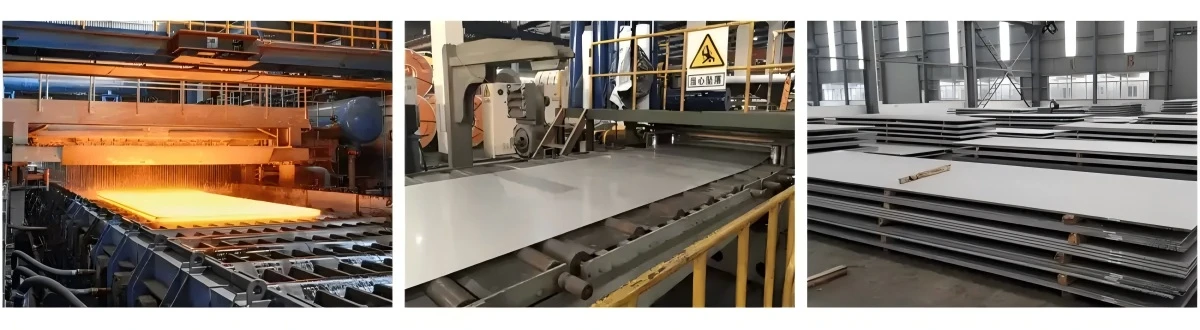
Plates and Sheets: Used for fabricating heavy-walled pressure vessels, storage tanks, and reactor shells, requiring certified thickness tolerances and ultrasonic testing.
Seamless and Welded Pipes: Essential for fluid transport under pressure; requires strict weld integrity verification and smooth internal finishes to prevent scaling or product entrapment.
Flanges and Fittings: Precision-machined components that maintain leak-proof joints under thermal cycling and mechanical vibration.
Securing reliable mill sources is crucial for large-scale chemical engineering projects. Direct manufacturing partnerships provide distinct advantages:
Custom Metallurgy & Dimensions: Capability to produce non-standard pipe diameters, heavy-gauge plates, and specialized fittings tailored to engineering blueprints.
Comprehensive Quality Assurance: Rigorous testing protocols—including PMI (Positive Material Identification), intergranular corrosion testing (e.g., Strauss test), and hydrostatic testing—guarantee compliance with ASTM, ASME, and EN standards.
Reliable Global Export Logistics: Professional packaging, corrosion-resistant protective coating, and stable shipping schedules designed for international industrial supply chains.
Frequently Asked Questions (FAQ)
1. Why is Grade 316L preferred over 304L in chemical processing?Grade 316L contains 2–3% molybdenum, which significantly enhances its resistance to chlorides, pitting corrosion, and various organic acids commonly found in chemical environments.
2. What are the main benefits of duplex stainless steels like 2205 in chemical plants?Duplex stainless steels offer a dual-phase microstructure (austenite and ferrite) that provides roughly twice the yield strength of standard austenitic grades, along with outstanding resistance to chloride stress corrosion cracking.
3. How does chemical composition affect intergranular corrosion resistance?Lower carbon content (as denoted by the "L" suffix, such as 304L or 316L) minimizes chromium carbide precipitation during welding, preserving corrosion resistance near weld seams without requiring post-weld heat treatment.
4. Can custom stainless steel pipe lengths and pressure ratings be manufactured for specific projects?Yes. Modern production lines support custom dimensions, specialized wall thicknesses (Sch 40, Sch 80, XXS), and certified pressure ratings to meet rigorous plant design specifications.